We have compiled a list of manufacturers, distributors, product information, reference prices, and rankings for For coating.
ipros is IPROS GMS IPROS One of the largest technical database sites in Japan that collects information on.

For coating Product List and Ranking from 4 Manufacturers, Suppliers and Companies | IPROS GMS

For coating Product List

1~5 item / All 5 items

Displayed results

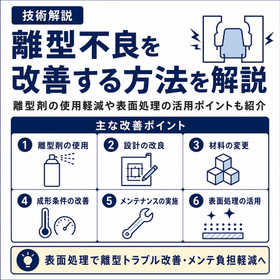
What is a method to reduce the release resistance of the ejector pin? Countermeasures through surface treatment.

Solve ejector pin troubles with surface treatment technology! Easy demolding even with soft resins that are less likely to stick.

■What is an ejector pin? Also known as a push-out pin, it is a pin incorporated into a mold to push out and remove molded products from the mold. Ejector pins are used in most injection molding molds and come in various shapes, materials, and sizes. It is important to choose the appropriate pin for demolding based on combinations of shapes such as round pins, square pins, and middle flange pins, as well as materials like SKD-61 and SKH-51. ■Methods to reduce the demolding resistance of ejector pins To reduce the demolding resistance of ejector pins, methods include mold design, pin arrangement and shape selection, and reviewing molding conditions. However, in cases of materials that tend to stick or soft resins, sticking can lead to demolding failures. In such cases, it is necessary to consider utilizing surface treatment technologies. ■Surface treatments to improve the demoldability of ejector pins Ejector pins need to protrude from the mold, so they require not only demoldability but also wear resistance and dimensional stability. Yoshida SKT's Bicoat has a proven track record of achieving smooth demolding when applied to ejector pins. For more details on Bicoat, please download the catalog and check.

  • Other surface treatment equipment
  • For coating

Added to bookmarks

Bookmarks list

Bookmark has been removed

Bookmarks list

You can't add any more bookmarks

By registering as a member, you can increase the number of bookmarks you can save and organize them with labels.

Free membership registration

High grip grade

From requests to increase the friction coefficient to requests for a coating that does not slip at all.

We would like to introduce the "High Grip Grade" that we handle. This grade has performance opposite to that of solid lubrication coatings. We respond to a wide range of requests, from simply wanting to increase the friction coefficient to wanting to make surfaces completely non-slippery. There are cases where components that utilized the adhesive properties of rubber have been replaced with a coating film of just a few tens of micrometers. Additionally, we are developing technology to make building handrails less slippery in order to propose comfortable living environments in an aging society. 【Features】 ■ Provision of stickiness ■ High friction coefficient *For more details, please refer to the PDF materials or feel free to contact us.

  • Coating Agent
  • For coating

Added to bookmarks

Bookmarks list

Bookmark has been removed

Bookmarks list

You can't add any more bookmarks

By registering as a member, you can increase the number of bookmarks you can save and organize them with labels.

Free membership registration

New DLC / NEO-C Example: Compressor Vane

The rotary CO2 compressor vane of the heat pump electric water heater "Mitsubishi Eco Cute" has adopted NEO-C.

■Compressor Vanes / Mitsubishi Electric Corporation Our DLC/NEO-C coating has been adopted for the surface treatment of the vanes in the rotary CO2 compressor used in the heat pump electric water heater "Mitsubishi Eco Cute," contributing significantly to quality improvement.

  • Other pumps
  • Special Pump
  • Vacuum pump
  • For coating

Added to bookmarks

Bookmarks list

Bookmark has been removed

Bookmarks list

You can't add any more bookmarks

By registering as a member, you can increase the number of bookmarks you can save and organize them with labels.

Free membership registration

Heavy wire wedge surface treatment/coating solution

Achieving longer lifespan for wedge bonding tools! Increased bonding cycles until the first cleaning, suitable for wear reduction. *Support from research institutions available.

Micro Point Pro's "Heavy Wire Wedge Surface Treatment/Coating" maintains high-quality bonding performance while achieving reduced buildup and wear. As a countermeasure against buildup, we offer four types of coatings using carbon-based and silicon-based materials. 【Features】 ■ Long-term bonding and tool life ■ Attractive pricing ■ Support for consignment and custom products ■ Assistance with new tool development and design support for customers ■ Special tool marking options

Added to bookmarks

Bookmarks list

Bookmark has been removed

Bookmarks list

You can't add any more bookmarks

By registering as a member, you can increase the number of bookmarks you can save and organize them with labels.

Free membership registration

Why does resin stick to the mold? The mechanism behind adhesion and release failure.

"Even with the use of release agents, the resin sticks to the mold..." This phenomenon is related to surface energy. We will introduce the mechanism of adhesion and the direction of countermeasures.

■Why "Sticking" Occurs When substances come into contact, a force that attracts them at the molecular level is generated due to the action of surface energy (surface tension). If the energy of the mold surface is high, molten resin or rubber is drawn to the mold surface, making it difficult to detach even after cooling and solidification. ■Cases Where Release Agents Alone Do Not Provide a Fundamental Solution Release agents are effective as a temporary measure, but they need to be applied each time a shot is made. Additionally, the components of the release agent can transfer to the product, leading to quality issues. ■Permanent Solutions Through Surface Treatment By applying surface treatment that lowers the energy of the mold surface, it is possible to ensure stable release properties even without a release agent. We have introduced a typical mechanism of release failure, but the causes of sticking vary depending on the type of resin, shape, molding temperature, pressure, and other factors at each site. The information provided is not exhaustive, and it is not uncommon for multiple factors to be intertwined. At Yoshida SKT, we carefully listen to our customers' molding conditions and materials to propose the optimal surface treatment. If you are struggling with release issues, please feel free to consult with us.

  • s-2021-06-22 (3).gif
  • ホットメルト_edited.jpg
  • IMG_9472_edited2.jpg
  • s-ロール.jpg
  • IMG_9363_edited.jpg
  • s-0197UJedit.jpg
  • DSC04626_edited.jpg
  • Processing Contract
  • For coating

Added to bookmarks

Bookmarks list

Bookmark has been removed

Bookmarks list

You can't add any more bookmarks

By registering as a member, you can increase the number of bookmarks you can save and organize them with labels.

Free membership registration